
Vitamins in skin care helps to support important body reactions like skin repair, protection, and new cell formation. Some vitamins help enzymes work better in making collagen, which keeps skin strong and healthy. This process can be shown simply as: amino acid + oxygen + vitamin → modified amino acid (collagen building block). Vitamins also help the skin produce energy and repair damaged cells, which keeps the skin fresh and smooth.
Vitamins also protect the skin from damage caused by pollution and sunlight by stopping harmful reactions in the skin. This can be written as: harmful free radical + vitamin → stable harmless molecule + changed vitamin form. This stops damage to skin cells and oils. Some vitamins also help switch on skin repair signals in cells: vitamin form + cell receptor → activated repair process → new healthy skin cells, which helps the skin heal and renew itself faster.
Top Vitamins for Skin Care
Vitamin A (Retinol)
Vitamin A (mainly in the form of retinol and retinoic acid) helps the skin to make the cell renewal process fast, reducing clogged pores, and increase the production of collagen. In simple terms, it help the old dead skin cells to shed faster and develop new healthy cells to form, which help in improves acne, fine lines, and uneven skin texture.
In the body, retinol is first converted into its active form, retinoic acid, then works by attaching the special cell receptors called RAR/RXR (retinoic acid receptors). This activates genes responsible for skin repair and renewal. The reaction can be shown simply as:
Retinoic acid + RAR/RXR receptor → Activated gene expression → new skin cell formation + collagen production
For acne control, Vitamin A also helps normalize how skin cells grow inside pores, preventing blockage:
Retinoic acid → regulated keratin production → less clogged pores → reduced acne formation
Vitamin C (Collagen Production)
Vitamin C (ascorbic acid) helps our skin mainly in glowing the skin tone and help in production of collagen, which keeps skin tighten, firm, and glowing. It works as a strong antioxidant, meaning it protects skin from damage caused by sunlight, pollution, and free radicals. Because of this protection, skin looks brighter and more even over time.
For collagen production, Vitamin C acts as a helper (cofactor) for enzymes that build strong collagen fibers in the skin. In simple chemical form:
Proline + Oxygen + Vitamin C → Hydroxyproline (collagen building block)
Lysine + Oxygen + Vitamin C → Hydroxylysine (collagen stability support)
These reactions help make collagen stronger, which improves skin elasticity and reduces wrinkles.
For skin brightening, Vitamin C reduces excess melanin (dark pigment) formation by slowing down the enzyme tyrosinase. This can be shown simply as:
Tyrosine (melanin precursor) + Vitamin C → reduced tyrosinase activity → less melanin → brighter skin tone
Vitamin E(Skin Protection)
itamin E (tocopherol) helps the skin mainly by keeping it moisturized and protecting it from damage caused by free radicals, skin pollution, and UV light. It is a fat-soluble antioxidant, which means it stays in the skin’s oil layer (lipid layer) and protects natural skin oils from breaking down. This helps prevent dryness, roughness, and early aging.
For moisturization and skin barrier protection, Vitamin E works by protecting the skin’s lipids (natural fats in the outer layer of skin). These lipids are important for holding water inside the skin. The simple chemical idea is:
Lipid (skin oil) + free radical → damaged lipid (dry skin)
But with Vitamin E:
Free radical + Vitamin E → stable molecule + oxidized Vitamin E (safe form)
This stops the damage chain reaction, so skin oils remain healthy and the skin stays hydrated and soft.
For skin protection, Vitamin E stops a process called lipid peroxidation (damage of skin fats). The simplified reaction is:
Lipid radical (L•) + Vitamin E → stable lipid (L–H) + Vitamin E radical
This prevents the spread of damage inside skin cell membranes, protecting skin cells from aging and inflammation.
Vitamin D (Barrier & Repair)
Vitamin D mainly helps in improving the skin barrier function, supporting repair, and strengthening immunity in skin cells. In the skin, Vitamin D is converted into its active form called calcitriol, which acts like a hormone and controls how skin cells grow, repair, and protect themselves from damage.
In simple biochemical terms, Vitamin D works by binding to a receptor inside skin cells called the Vitamin D receptor (VDR). This activates genes responsible for skin barrier repair and immune protection. The reaction can be shown as:
Calcitriol (active Vitamin D) + VDR receptor → Activated gene expression → production of skin barrier proteins + repair response
For skin barrier strengthening, it increases the production of proteins and lipids that keep the outer skin layer strong and prevent water loss:
Vitamin D signaling → increased barrier proteins (like filaggrin) + lipids → stronger skin barrier → less dryness
For skin repair and protection, it boosts natural antimicrobial peptides that protect skin from infection and inflammation:
Vitamin D activation → cathelicidin production → reduced bacteria + faster healing
Vitamin B3 (Niacinamide)
Vitamin B3 (Niacinamide) helps the skin mainly by controlling excess oil production and improving uneven skin tone. It also strengthens the skin barrier and reduces inflammation, which helps in acne and dull skin problems.
For oil control, niacinamide helps regulate the activity of sebaceous (oil) glands, reducing excess sebum production. In simple biochemical terms:
Niacinamide → ↑ NAD⁺ levels → balanced cellular energy → regulated sebaceous gland activity → less sebum (oil)
This means the skin produces a healthier amount of oil, reducing greasiness and clogged pores.
For even skin tone and brightening, niacinamide reduces the transfer of melanin (pigment) from melanocytes to skin cells. The simplified reaction is:
Melanin transfer (melanosome) + Niacinamide → reduced pigment transfer → more even skin tone + reduced dark spots
Vitamin B5 (Healing)
Vitamin B5 (Pantothenic acid / Panthenol) helps the skin mainly by deep hydration and faster wound healing. It is widely used in skincare because it improves the skin’s ability to hold moisture in it and also supports the natural skin repair processes, making skin soft, calm, and healthy.
For hydration, Vitamin B5 (especially panthenol) attracts and holds water in the skin by acting as a humectant. In simple terms:
Panthenol + water → retained moisture in skin layer → improved hydration + softer skin
Inside the skin, it also helps form Coenzyme A (CoA), which supports lipid (fat) metabolism and strengthens the skin barrier:
Pantothenic acid → CoA → increased lipid production → stronger skin barrier → less water loss
For healing and repair, Vitamin B5 supports cell regeneration and reduces inflammation, helping damaged skin recover faster. The simplified process is:
Panthenol → ↑ cell repair activity + ↑ fibroblast function → faster tissue regeneration → improved wound healing
Vitamin K ( Dark Circles)
Vitamin K helps in reducing dark circles, bruising, and skin discoloration, especially under the eyes. It is important for proper blood function and in healing process because it supports the body’s process of blood clotting and circulation repair. When blood leaks under the thin under-eye skin, it can form dark pigmentation area, and Vitamin K helps the body clear this faster.
For dark circles, Vitamin K supports the breakdown and reabsorption of leaked blood pigments (like hemoglobin) from tiny capillaries. In simple biochemical terms:
Hemoglobin breakdown products + Vitamin K → faster clearance by blood vessels → reduced bluish/purple discoloration
It also helps improve blood clotting and reduces micro-bleeding under the skin, which prevents new dark pigmentation from forming:
Vitamin K → activation of clotting proteins → reduced capillary leakage → less pigment buildup → lighter under-eye area
Natural Sources of Skin Vitamins
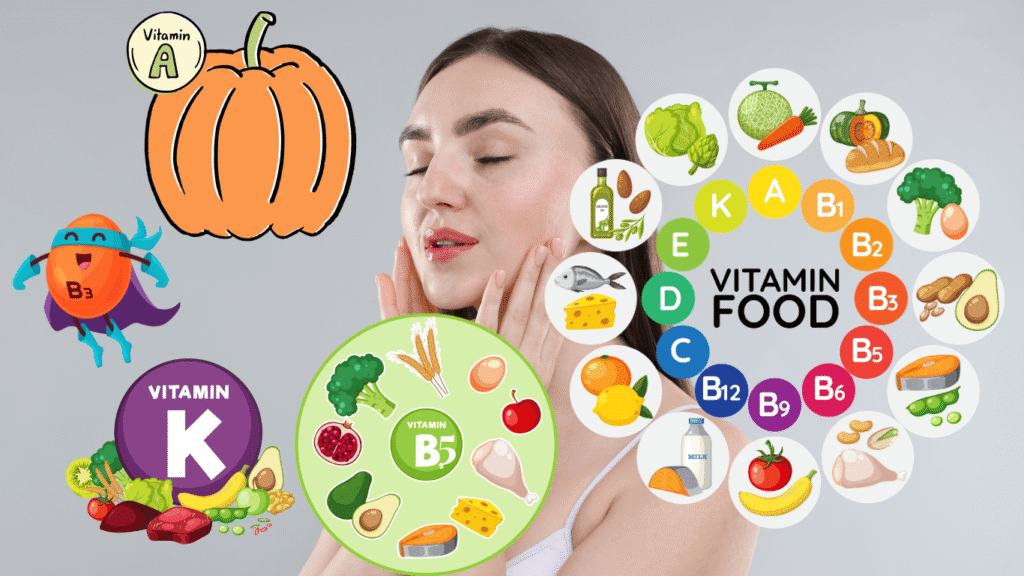
Vitamin A (Retinol/Carotenoids) helps skin repair and smoothness. It is found in carrots, sweet potatoes, spinach, mango, papaya, milk, and eggs. These foods support new skin cell formation and healthy texture.
Vitamin C supports collagen and bright skin. It is found in orange, lemon, amla, guava, kiwi, strawberries, bell peppers, and tomatoes. These foods help skin stay firm and reduce dullness.
Vitamin E protects skin from damage and dryness. It is found in almonds, sunflower seeds, peanuts, avocado, spinach, and olive oil. These help keep skin soft and moisturized.
Vitamin D supports skin barrier and repair. It is found in sunlight exposure, egg yolk, fortified milk, and fatty fish (like salmon). Sunlight is the main natural source.
Vitamin B3 (Niacin) helps oil control and skin tone. It is found in chicken, fish, peanuts, mushrooms, whole grains, and green vegetables. These support balanced and clear skin.
Vitamin B5 (Pantothenic acid) helps hydration and healing. It is found in mushrooms, eggs, yogurt, avocados, broccoli, and legumes (beans, lentils). These help skin stay hydrated and repair faster.
Vitamin K helps reduce dark circles and improve circulation. It is found in green leafy vegetables like spinach, kale, cabbage, broccoli, and lettuce. These help improve skin tone and healing.
FAQ About Vitamins for Skin Care
Which vitamin is better for skin care?
No single vitamin is “best” for skin care because each works differently.
However, Vitamin C, Vitamin E, and Vitamin A are the most important for healthy, glowing skin.
Vitamin C is especially popular for brightness and collagen production, so it is often considered the best overall.
Which vitamins are useful for skin?
Several vitamins are essential for healthy skin. The most useful are Vitamin A, Vitamin C, Vitamin E, Vitamin D, Vitamin B3 (Niacinamide), and Vitamin B5. These vitamins help in skin repair, hydration, protection, and improving natural glow and texture.
What are the big 3 vitamins?
The “big 3 vitamins” for skin care are Vitamin A, Vitamin C, and Vitamin E. These are the most powerful antioxidants for skin health. They help in skin repair, brightening, protection, and reducing signs of aging.
What vitamins help with neuropathy?
Vitamins that may help with neuropathy include Vitamin B1 (thiamine), B6, and B12. These support healthy nerve function and repair. Vitamin E may also help protect nerves from oxidative damage.
Can vitamin D deficiency cause neuropathy?
Yes, vitamin D deficiency may contribute to nerve pain and neuropathy symptoms in some people. Low vitamin D can affect nerve function and increase inflammation. However, neuropathy usually has multiple causes, so proper medical evaluation is important.
Pingback: Beetroot for Skin The Natural Glow Booster - Healixcare
Pingback: How to Use Multani Mitti for Clear Skin - Healixcare
Pingback: Aloe Vera for Skin Benefits and DIY Face Packs - Healixcare
Pingback: Benefits Of Raw Milk Benefits for Skin Glow, Acne Relief - Healixcare